
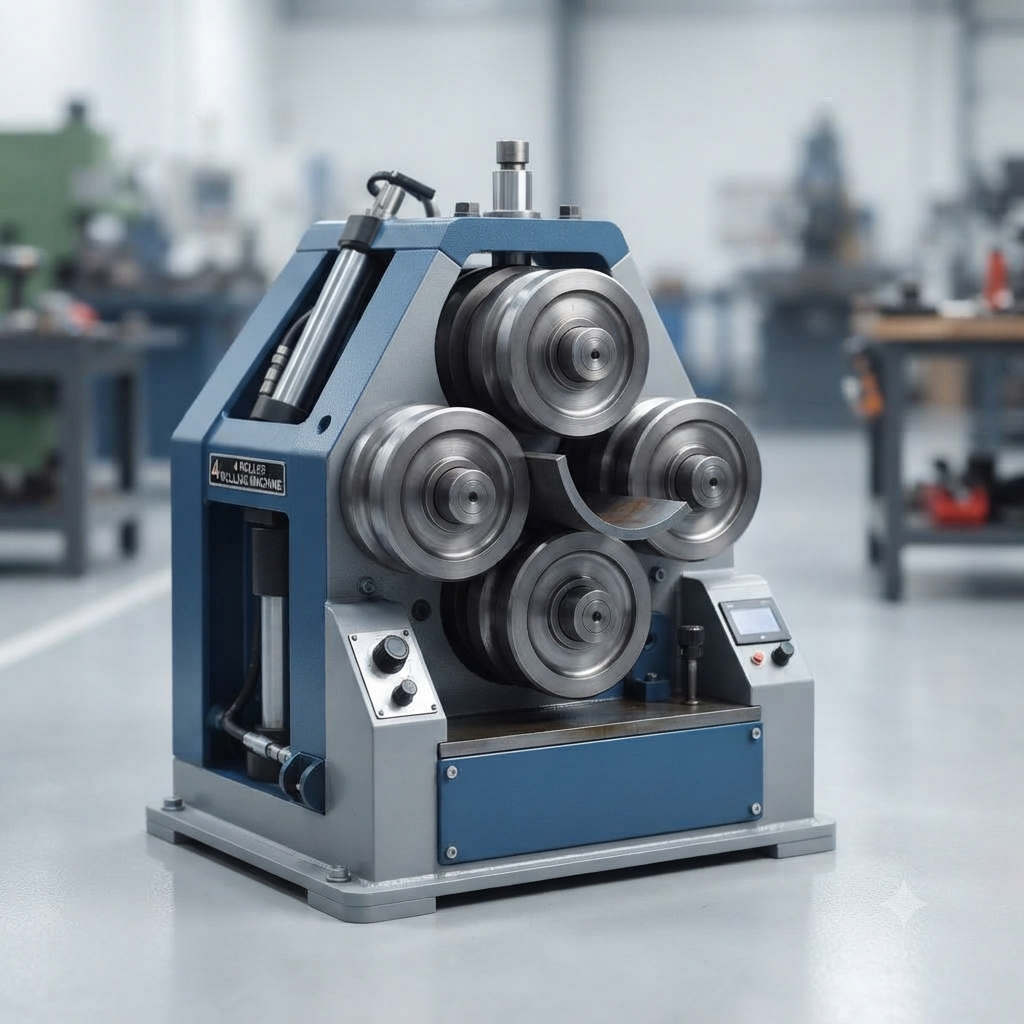
A 4 roller rolling machine is an advanced metal forming machine used to bend steel, aluminum, stainless steel, and other metal sheets into cylindrical or conical shapes. It is widely used in industries such as pressure vessel manufacturing, wind tower production, shipbuilding, aerospace, and heavy fabrication. Compared with 3-roll machines, a 4-roll plate bending machine offers higher accuracy, faster operation, and better control during the rolling process.
How a 4 Roller Rolling Machine Works
The machine consists of four rollers:
- Top roller – applies the main driving force.
- Bottom roller – supports and feeds the plate.
- Two side rollers – move independently to create the required bending radius.
The metal sheet is clamped between the top and bottom rollers, while the side rollers gradually bend the plate into the desired shape. This design allows pre-bending on both ends without removing the sheet, reducing material waste and improving productivity.
Key Advantages
Higher Accuracy
Because the plate remains clamped during the entire operation, the machine produces uniform and precise bends.
Faster Production
A 4-roll machine can complete feeding, pre-bending, and rolling in a single setup, saving time and labor.
Better Safety
The clamping mechanism prevents the sheet from slipping, making operation safer for workers.
Suitable for CNC Automation
Modern machines are available with CNC control systems, enabling automatic radius calculation and repeatable production.
Comparison: 3 Roller vs 4 Roller Rolling Machine
| Feature | 3 Roller | 4 Roller |
| Pre-bending | Limited | Excellent |
| Rolling accuracy | Medium | High |
| Automation | Basic | Advanced CNC |
| Material handling | Manual | Easier |
| Production speed | Moderate | High |
Applications
Pressure Vessel Manufacturing
Used for forming boiler shells, storage tanks, and heat exchangers.
Wind Energy Industry
Essential for rolling large wind tower sections with tight tolerances.
Shipbuilding
Helps create curved hull sections and structural components.
General Fabrication
Used for pipes, ducts, silos, and heavy steel structures.
Important Buying Factors
When selecting a 4 roller rolling machine, consider:
- Plate thickness capacity – maximum thickness the machine can bend.
- Rolling width – length of the plate that can be processed.
- Roller diameter – affects the minimum achievable bending radius.
- Hydraulic or mechanical drive – hydraulic systems provide greater force and flexibility.
- CNC features – useful for high-volume and precision manufacturing.
Maintenance Tips
Proper maintenance increases machine life and ensures consistent performance:
- Lubricate roller bearings regularly.
- Check hydraulic oil levels and filters.
- Inspect rollers for wear or surface damage.
- Calibrate the CNC system periodically.
- Keep the machine clean and free from metal debris.
FAQs
What is a 4 roller rolling machine used for?
It is used to bend metal plates into cylindrical or conical shapes.
Is it better than a 3-roll machine?
Yes, it offers better accuracy, faster setup, and easier operation.
Can it bend stainless steel?
Yes, most machines are designed for stainless steel, aluminum, and carbon steel.
What industries use it most?
Pressure vessel, wind energy, shipbuilding, and heavy fabrication industries.
What is pre-bending?
Pre-bending forms the plate edges before full rolling, reducing flat ends.
Is CNC control necessary?
For repetitive and precision jobs, CNC control is highly recommended.
What thickness can it handle?
Capacities range from a few millimeters to over 100 mm, depending on the model.
Does it require skilled operators?
Basic models require training, while CNC machines are easier to operate.
How often should it be serviced?
Routine inspection should be done weekly, with full servicing as recommended by the manufacturer.
What is the main advantage?
The biggest advantage is high-precision rolling with minimal material waste.