
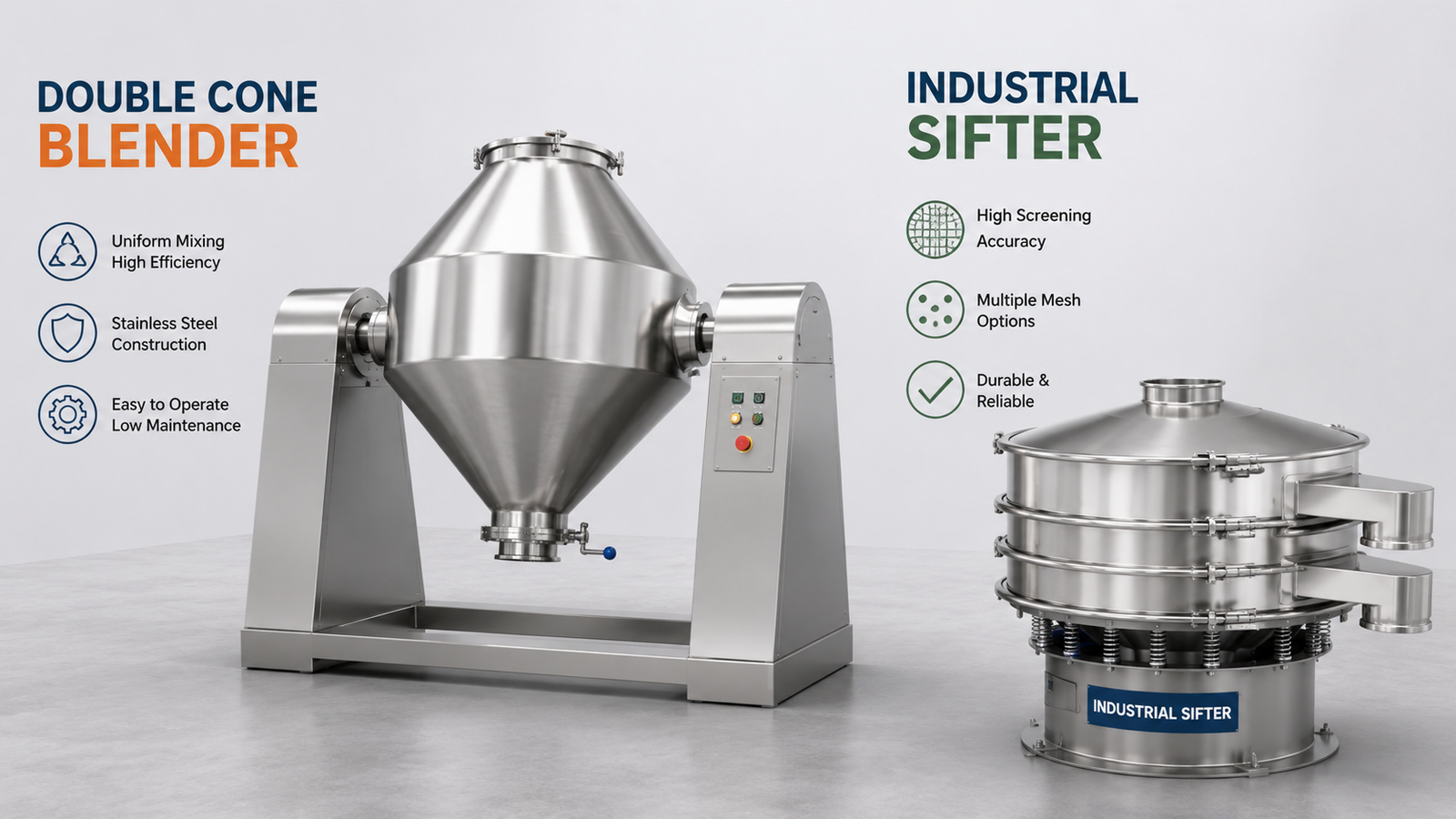
A double cone blender is a batch mixing machine designed to produce a consistent blend of dry powders and granules. Its simple vessel geometry, gentle mixing action and relatively low maintenance requirements make it a popular choice across pharmaceutical, food, chemical and other process industries.
For manufacturers selecting powder-processing equipment, the blender is rarely considered in isolation. The complete process may also require equipment such as an industrial sifter for screening, de-lumping and particle-size control before or after blending.
This guide explains how a double cone blender works, where it fits into a powder-processing line, what to consider when specifying one, and when an alternative mixer may be more appropriate.
What Is a Double Cone Blender?
A double cone blender is a rotating mixing vessel made from two conical sections joined at their widest point. Dry ingredients are loaded into the vessel, which then rotates around a horizontal axis.
As the vessel turns, the powder repeatedly moves, rolls and cascades within the chamber. This movement encourages the different ingredients to distribute throughout the batch.
Unlike high-shear mixers, a double cone blender generally relies on tumbling rather than intensive mechanical agitation. That makes it particularly suitable for products where gentle handling is important.
How does a double cone blender work?
The basic operating sequence is straightforward:
1. Dry powders or granules are charged into the mixing vessel.
2. The vessel is securely closed.
3. The blender rotates at a controlled speed.
4. Material is lifted and allowed to cascade through the powder bed.
5. Repeated movement progressively distributes the ingredients.
6. The blended product is discharged through the outlet.
The actual mixing performance depends on factors such as particle size, density, shape, moisture, fill level, rotation speed and formulation.
Why Use a Double Cone Blender for Powder Mixing?
One of the main advantages of this equipment is its relatively gentle mixing mechanism.
For free-flowing powders and granules that do not require aggressive shear, the tumbling action can provide an effective way to achieve batch uniformity while limiting unnecessary mechanical stress.
Other potential benefits include:
· Gentle product handling: useful for powders and granules that may be sensitive to excessive shear.
· Simple construction: the rotating vessel has fewer internal moving components than some more complex mixer designs.
· Accessible cleaning: a suitable sanitary design can simplify cleaning and inspection.
· Closed processing: enclosed operation can help reduce exposure to dust and contamination when the system is correctly configured.
· Flexible batch processing: equipment can be specified for different production requirements.
· Integration potential: the blender can form part of a wider powder-handling line involving sifters, conveyors, feeders and filling equipment.
However, a double cone blender is not automatically the best choice for every formulation. Equipment selection should be based on the material characteristics and the required process outcome rather than vessel capacity alone.
Double Cone Blender vs Other Powder Mixers
Different mixing technologies produce different types of material movement.
A double cone blender is generally most appropriate when the product is a reasonably free-flowing dry powder or granule and gentle tumbling is desirable.
A ribbon blender, for example, uses an internal agitator and can provide more active movement of the powder. A ploughshare mixer may be preferable where more intensive mixing or the handling of cohesive materials is required.
High-shear mixers are designed for applications where significantly greater mechanical energy is necessary.
The right question is therefore not simply, “Which blender has the largest capacity?” It is:
Which mixing mechanism best matches the physical properties of the product and the required degree of mixing?
For difficult formulations, pilot testing or trials with the actual material can be valuable before final equipment selection.
What Materials Can Be Processed?
Double cone blenders are commonly considered for dry, free-flowing materials such as:
· Pharmaceutical powders and excipients
· Food ingredients
· Nutraceutical powders
· Chemical powders
· Mineral products
· Ceramic materials
· Detergent ingredients
· Dry premixes
· Granulated products
The suitability of a particular machine depends on the formulation.
For example, two powders with identical average particle sizes can behave very differently if their bulk densities, surface properties or moisture levels differ significantly.
Why particle characteristics matter
Segregation can become a concern when ingredients differ substantially in:
· Particle size
· Density
· Shape
· Flow characteristics
· Surface properties
A blend that appears uniform immediately after mixing can potentially segregate during discharge, conveying or subsequent handling.
This is why powder-processing equipment should be considered as a complete process rather than as a standalone machine.
The Role of an Industrial Sifter in a Powder-Processing Line
An industrial sifter is commonly used to screen powders or granules and remove unwanted oversize particles, lumps or foreign material.
Depending on the process, screening may take place before blending, after blending, or at another stage of production.
For example:
Raw material → Industrial sifter → Double cone blender → Final screening → Packing
In another application, the sifter may be positioned after blending to remove agglomerates before the product moves to packaging.
Why combine sifting and blending?
The two operations solve different processing problems.
A sifter primarily separates material according to particle size or removes unwanted oversize material. A blender distributes different ingredients throughout a batch.
Using both technologies in the correct sequence can therefore support a more controlled powder-processing operation.
The exact configuration should be determined by the formulation, required particle-size distribution, hygiene requirements and downstream process.
Key Factors When Choosing a Double Cone Blender
Equipment selection should start with the product rather than the machine.
1. Product characteristics
Provide the equipment supplier with information about the materials being processed, including:
· Bulk density
· Particle size
· Moisture content
· Flowability
· Cohesiveness
· Abrasiveness
· Sensitivity to shear
· Potential for segregation
These properties can have a significant effect on mixing behaviour.
2. Batch size and working capacity
Do not select equipment solely on the basis of the vessel’s total geometric volume.
The working volume required for effective mixing can differ from the vessel’s maximum volume. The appropriate fill level depends on the product and mixing mechanism.
A supplier should therefore evaluate both the required batch size and the material’s behaviour.
3. Construction material
Stainless steel is widely used for applications where hygiene, corrosion resistance and cleanability are important.
The appropriate grade and surface finish depend on the product and industry requirements.
Pharmaceutical and food applications may have more demanding requirements than general industrial powder handling.
4. Internal design
Some applications may require additional features such as:
· Internal intensifier bars
· Spray systems
· Special seals
· Special discharge arrangements
· Polished product-contact surfaces
· Dust-tight construction
An intensifier bar, for example, can increase localised mixing action when a formulation requires more than conventional tumbling.
It should not, however, be treated as a universal solution for poorly flowing or highly cohesive materials.
5. Loading and discharge
Consider how material will enter and leave the blender.
Important questions include:
· Is the product loaded manually or automatically?
· Does the system need vacuum or gravity loading?
· How will dust be controlled?
· What discharge valve is appropriate?
· Does the outlet need to connect directly to a downstream sifter or filling system?
· How easily can residual material be removed?
These details can have a major impact on real-world productivity and cleaning.
Hygiene and Cleaning Considerations
For food, pharmaceutical and nutraceutical applications, hygienic design should be considered from the beginning of the specification process.
Look for a configuration that provides suitable access for inspection and cleaning while minimising areas where powder can accumulate.
Depending on the application, requirements may include:
· Appropriate stainless-steel construction
· Smooth product-contact surfaces
· Hygienic seals and valves
· Accessible inspection points
· Reduced product retention
· Suitable cleaning procedures
· Validation or documentation requirements
Cleaning requirements should be discussed with the equipment manufacturer before purchase rather than treated as an afterthought.
How to Improve Mixing Performance
Buying a larger blender does not necessarily produce a better blend.
Consistent performance is influenced by the complete operating window.
Control the fill level
An unsuitable fill level can affect material movement inside the vessel. The optimum level depends on the formulation and blender design.
Control rotation speed
Increasing speed does not automatically improve mixing. Excessive speed can change the movement pattern of the material and may increase the risk of undesirable effects such as segregation.
Establish an appropriate mixing time
Longer mixing is not always better.
Once an acceptable blend has been achieved, additional mixing may provide little benefit and could potentially contribute to segregation in some formulations.
The correct mixing time should therefore be established through trials and product testing.
Consider the loading sequence
The order in which ingredients are introduced can influence the final blend, particularly where there are large differences in concentration, density or particle size.
A low-dose active ingredient, for example, may require a controlled pre-blending strategy rather than simply being added to the full batch.
Common Applications
A double cone blender may be considered for applications including:
Pharmaceutical manufacturing
Used for blending powders and granules where controlled batch uniformity and hygienic construction are important.
Food processing
Suitable for selected dry ingredient and premix applications, subject to formulation and hygiene requirements.
Chemical processing
Can be used for a range of dry chemical blends where gentle tumbling is appropriate.
Nutraceutical production
May be suitable for blending powdered ingredients, provided segregation and dosage uniformity are properly evaluated.
What Should You Ask a Blender Manufacturer?
Before requesting a quotation, prepare as much process information as possible.
A useful equipment enquiry should include:
· Product name and description
· Number of ingredients
· Batch size
· Bulk density
· Particle-size range
· Moisture content
· Required mixing uniformity
· Target production rate
· Loading method
· Discharge method
· Cleaning requirements
· Material of construction
· Hazardous-area requirements, if applicable
· Whether an industrial sifter is required elsewhere in the process
The more complete the information, the easier it is for an equipment manufacturer to recommend a suitable configuration.
Internal link opportunity: Link “powder processing equipment” to your main powder-processing equipment category page.
Internal link opportunity: Link “industrial sifter” to your industrial sifting/separation equipment page.
Internal link opportunity: Link “pharmaceutical mixing equipment” to your pharmaceutical equipment category page.
Frequently Asked Questions
What is a double cone blender used for?
A double cone blender is used to mix dry powders and granules into a more uniform batch. It is particularly suited to free-flowing products where gentle tumbling is preferred over high-shear mixing.
Is a double cone blender suitable for pharmaceutical powders?
It can be suitable for pharmaceutical powder and granule applications, provided the blender’s construction, cleaning provisions, containment, batch capacity and mixing performance meet the requirements of the specific formulation and manufacturing process.
What is the difference between a double cone blender and a ribbon blender?
A double cone blender mixes through the tumbling movement of a rotating vessel, while a ribbon blender uses an internal agitator to move the material. Double cone designs are often considered where gentle mixing is desirable; ribbon blenders can provide more active mechanical movement.
Can a double cone blender mix powders of different densities?
It can, but density differences can increase the risk of segregation. Particle size, shape, flow properties and the formulation itself should also be evaluated. Process trials are often useful when density differences are significant.
What does an industrial sifter do?
An industrial sifter separates particles by size and can remove oversize material, lumps or unwanted foreign particles. Its position in the process depends on the desired particle-size control and the characteristics of the product.
How do I choose the right blender capacity?
Start with the required batch size and material bulk density, then consider the blender’s recommended working volume rather than simply its total vessel volume. The product’s flow and mixing characteristics should also be considered.