
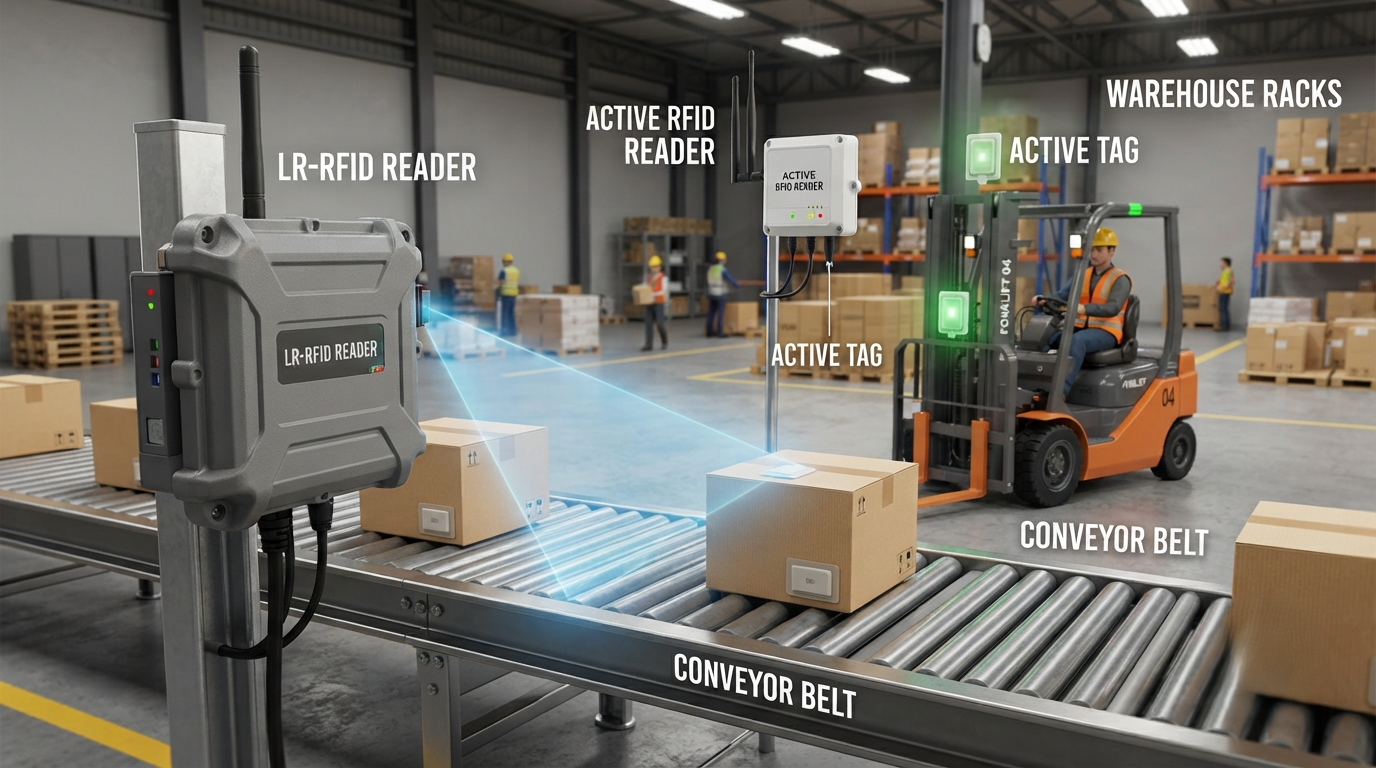
As operations become larger and faster, Radio Frequency Identification technology offers an efficient way to collect identification data without requiring direct line-of-sight scanning.
Two technologies that are particularly valuable for large-scale tracking are the Long Range RFID Reader and the Active RFID Reader. Although both are designed to identify RFID-enabled objects across greater distances, they work differently and suit different operational environments.
Understanding these differences helps businesses build an RFID system that improves visibility, reduces manual work, and supports better operational decisions.
What Is a Long Range RFID Reader?
A Long Range RFID Reader is an RFID device designed to communicate with compatible tags from a greater distance than conventional short-range readers.
Many long-range applications use UHF RFID technology. Passive UHF RFID commonly operates in the 860–930 MHz range and can provide reading distances of several meters depending on the tag, antenna, reader configuration, regulations, and installation environment.
Instead of scanning each item individually, a properly designed reader installation may identify multiple tagged objects automatically.
This makes long-range RFID useful in:
- Warehouses
- Distribution centers
- Manufacturing facilities
- Parking areas
- Logistics yards
- Retail inventory systems
- Asset management facilities
- Entry and exit checkpoints
The technology can significantly reduce repetitive scanning when assets constantly move between operational zones.
How Does Long Range RFID Reading Work?
A reader communicates with RFID tags through radio-frequency signals. With passive UHF RFID, the tag does not require its own transmitter. Instead, it receives energy from the reader signal and responds using backscatter communication.
Reader and Antenna Communication
The reader generates the RF signal while one or more antennas define the intended reading area. Tags entering this RF field can respond with their stored identification information.
RFID software then processes that information and may connect it with:
- Product databases
- Warehouse management systems
- ERP platforms
- Inventory applications
- Access management systems
- Asset tracking dashboards
Why Antenna Selection Matters
Simply installing a high-powered reader does not guarantee better performance.
Important Installation Factors
RFID performance can be affected by antenna placement, tag orientation, surrounding materials, interference, reader settings, and the physical environment.
Therefore, RFID deployment should focus on creating the correct reading zone rather than simply maximizing theoretical distance.
What Is an Active RFID Reader?
An Active RFID Reader communicates with active RFID tags that contain their own transmitter and typically have an internal power source such as a battery.
Unlike passive tags, which rely on energy supplied by the reader signal, active tags can transmit their own signals.
This characteristic makes active RFID particularly suitable for tracking valuable or mobile assets over extended areas.
Typical applications include:
- Vehicle tracking
- Heavy equipment monitoring
- Container identification
- Mining operations
- Construction equipment tracking
- Industrial asset management
- Yard management
- Large campus environments
Because active tags contain additional electronics and power components, they normally cost more than passive labels.
Long Range RFID Reader vs Active RFID Reader
Although the terms are sometimes used together, they represent different RFID concepts.
| Feature | Long Range Passive RFID | Active RFID |
| Tag power | No internal battery normally required | Usually battery powered |
| Communication | Reader energizes tag | Tag can transmit its own signal |
| Tag cost | Generally lower | Generally higher |
| Maintenance | Minimal tag maintenance | Battery management may be needed |
| Best suited for | Inventory and item identification | Valuable mobile asset tracking |
| Typical applications | Warehouse, retail, logistics | Vehicles, equipment, containers |
| Deployment scale | Suitable for high tag volumes | Better for selected valuable assets |
Passive UHF RFID systems often work with GS1 EPC Gen2 and ISO/IEC 18000-63 standards, supporting interoperable item-identification applications.
Benefits of Long Range RFID Technology
Companies implementing a Long Range RFID Reader can automate identification processes that previously required employees to scan barcodes manually.
Important benefits include:
- Faster asset identification
- Reduced dependence on manual scanning
- Improved inventory visibility
- Better movement tracking
- Reduced data-entry errors
- Automated entry and exit detection
- Greater warehouse efficiency
- Real-time operational information
For example, tagged cartons moving through a warehouse checkpoint may be identified automatically without workers scanning every barcode individually.
Benefits of Active RFID Technology
An Active RFID Reader can be particularly effective where organizations need visibility into valuable assets moving across a large facility.
Active technology may provide:
- Extended detection capability
- Automated asset visibility
- Faster location awareness
- Improved equipment utilization
- Reduced search time
- Better security monitoring
- Support for large outdoor environments
Active RFID is especially useful when the value of tracking the asset justifies the higher tag cost.
Which RFID Technology Should You Choose?
Choosing between passive long-range RFID and active RFID should begin with the business requirement rather than the hardware.
Consider five important questions:
- What needs to be tracked?
- How far away must tags be detected?
- How many assets require tags?
- Is the environment indoor or outdoor?
- What budget is available per tagged asset?
For thousands of cartons or individual retail products, passive RFID can be more economical.
For vehicles, machinery, containers, or expensive equipment spread across a large site, active RFID may provide greater practical value.
Some organizations use both technologies within the same operation.
Key Factors Before Installing an RFID System
Before selecting an Active RFID Reader or Long Range RFID Reader, organizations should conduct a site assessment.
Important considerations include reader location, RF regulations, frequency compatibility, environmental conditions, antenna coverage, software integration, tag mounting surface, network connectivity, scalability, and cybersecurity.
A pilot installation is often useful before a complete rollout because real-world RFID performance depends heavily on the operating environment.
Industries Using Long Range and Active RFID
RFID technology continues to support automation across numerous industries.
Common sectors include:
- Manufacturing
- Automotive
- Transportation
- Logistics
- Warehousing
- Healthcare
- Construction
- Retail
- Aviation
- Education
- Oil and gas
As digital operations expand, RFID data can also feed analytics platforms, ERP systems, and automated workflows.
FAQ About Long Range RFID and Active RFID
1. What is a Long Range RFID Reader?
It is an RFID reader designed to identify compatible RFID tags across longer distances than typical short-range identification systems.
2. What is an Active RFID Reader?
It is a reader designed to receive and process signals from active RFID tags containing their own transmitter and usually a battery.
3. Does active RFID provide longer range?
Active RFID is designed for long-range applications because active tags can transmit using their own power source.
4. Do passive RFID tags need batteries?
Standard passive RFID tags do not require batteries. They obtain operating energy from the reader’s RF signal.
5. Which RFID technology is cheaper?
Passive RFID tags are generally less expensive, making them practical for large numbers of products or inventory items.
6. Can RFID read multiple tags together?
Yes. Compatible RFID systems can identify multiple tags within a reading zone, making them useful for automated inventory operations.
7. Can RFID work without line of sight?
Yes. RFID uses radio communication, so tags generally do not require the direct optical visibility needed by barcode scanners.
8. What affects RFID reading distance?
Reader configuration, antennas, tag design, orientation, installation environment, surrounding materials, interference, and regulatory power limits can all affect performance.
9. Where is active RFID commonly used?
It is commonly selected for vehicles, industrial equipment, containers, valuable assets, and other objects moving through large operational areas.
10. Can passive and active RFID be used together?
Yes. Businesses may deploy passive RFID for high-volume inventory while using active RFID for valuable mobile assets.