
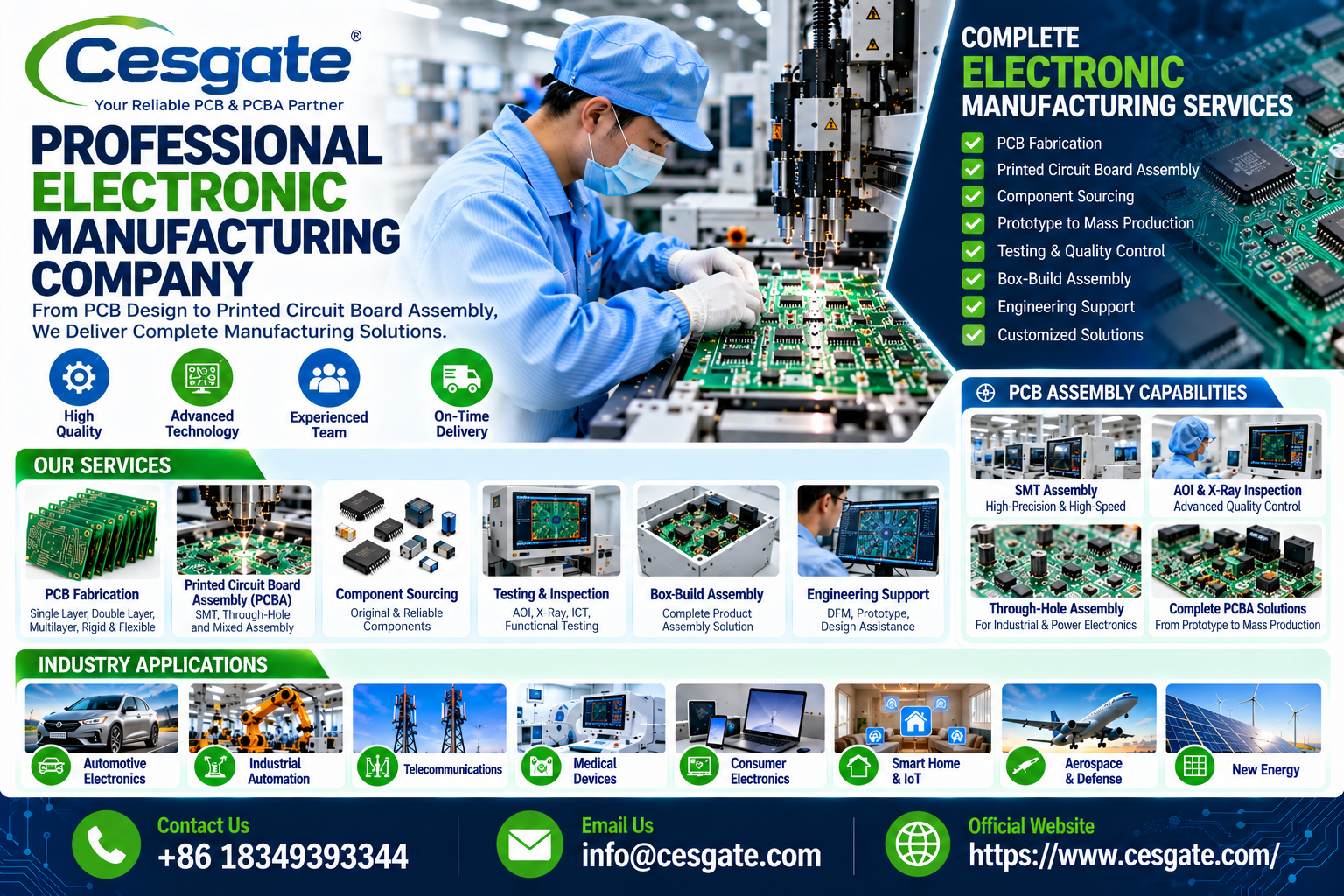
From industrial automation and outdoor monitoring equipment to transportation systems and specialised electronic controls, manufacturers must consider environmental conditions before approving a product for production.
A professional electronic manufacturing company can help translate technical designs into functional electronics through suitable materials, assembly processes, and manufacturing controls.
Meanwhile, high-quality printed circuit board assembly plays a critical role in ensuring electronic components remain properly connected and protected under specified operating conditions.
For original equipment manufacturers, product engineers, and industrial buyers, environmental reliability should be considered throughout the manufacturing process rather than treated as an additional requirement after production.
Why Environmental Reliability Matters in Electronics Manufacturing
Electronic circuits may operate in controlled indoor environments or locations exposed to challenging conditions.
Temperature variation can affect material expansion, while vibration may place mechanical stress on certain components and solder connections.
Moisture and contamination can also create electrical reliability concerns.
However, environmental exposure does not affect every product in the same way.
Manufacturing requirements should reflect the actual operating environment and expected product performance.
This approach encourages closer cooperation between engineering teams and manufacturing specialists.
What Does an Electronic Manufacturing Company Do?
An electronic manufacturing company provides manufacturing services for electronic products and components.
Depending on its capabilities, these services may include circuit board fabrication, component procurement, electronic assembly, product integration, inspection, and testing.
Manufacturers work from approved engineering specifications to produce assemblies suitable for their intended applications.
For environmentally demanding products, additional processes may be necessary.
These can include specialised cleaning, protective coating, mechanical reinforcement, or environmental verification.
However, such capabilities should be confirmed directly with the manufacturing provider.
Understanding Printed Circuit Board Assembly
Printed circuit board assembly is the process of installing and electrically connecting electronic components onto a fabricated printed circuit board.
Common assembly methods include surface mount technology and through-hole component installation.
The selected method depends on component construction, circuit requirements, and manufacturing considerations.
For products intended for challenging environments, designers must also evaluate component positioning and mechanical support.
An assembly that performs correctly under ordinary laboratory conditions may require additional protection for its final application.
The complete electronic design must therefore be assessed against the intended operating conditions.
How Temperature Changes Affect PCB Assemblies
Electronic products can experience changes in temperature during operation, transportation, and storage.
Different materials expand and contract at different rates.
These differences may create mechanical stress within certain electronic assemblies.
Thermal management also matters when components generate significant heat.
Engineers can address these challenges through appropriate material selection, circuit layout, component placement, and product enclosure design.
However, thermal reliability cannot be guaranteed through assembly workmanship alone.
Product-level engineering and suitable verification procedures remain essential.
Why Moisture Protection Requires Attention
Moisture can affect electronic products when it reaches susceptible components or conductive surfaces.
Under certain conditions, contamination combined with moisture may contribute to corrosion or unwanted electrical leakage.
Manufacturers may use suitable cleaning procedures and protective materials to reduce particular risks.
However, protection depends on the complete product construction.
Enclosure design, connectors, ventilation, sealing, and installation conditions can influence exposure.
A protective process should be selected according to the application rather than applied automatically to every circuit board.
Understanding Conformal Coating in Electronics
Conformal coating is a thin protective material applied to selected areas of an electronic assembly.
Depending on its formulation, it may help reduce exposure to moisture, contamination, and certain environmental conditions.
Different coatings have different chemical, mechanical, and electrical characteristics.
Some products may require masking around connectors, switches, or other components before coating.
Application quality and coating compatibility should be evaluated carefully.
Conformal coating is not a substitute for waterproof enclosure design or comprehensive environmental protection.
Manufacturers should follow approved specifications and suitable inspection procedures.
Environmental Challenges and Manufacturing Responses
| Environmental Challenge | Potential Concern | Engineering Consideration |
| Temperature Variation | Material stress | Suitable materials and thermal design |
| Moisture Exposure | Corrosion or electrical leakage | Cleaning and appropriate protection |
| Mechanical Vibration | Connection fatigue | Mechanical support and component placement |
| Dust Contamination | Surface contamination | Enclosure design and maintenance |
| Chemical Exposure | Material deterioration | Compatible protective materials |
| High Power Dissipation | Excessive component temperature | Thermal management and ventilation |
The correct response depends on the product’s operating requirements and design limitations.
Why Vibration Resistance Matters
Electronic assemblies used in moving equipment may experience repeated mechanical vibration.
This can create stress around heavy components, connectors, and solder joints.
Designers should consider suitable mounting arrangements and component support.
For certain applications, mechanical reinforcement or approved adhesive materials may be appropriate.
However, such materials can also affect maintenance, thermal performance, and manufacturing complexity.
Their use should be supported by engineering evaluation.
A reliable assembly design considers mechanical conditions alongside electrical functionality.
The Importance of PCB Cleaning
Contamination may remain on electronic assemblies after certain manufacturing operations.
Depending on the soldering materials and processes used, cleaning may be required to meet product specifications.
However, not every assembly requires the same cleaning process.
Some manufacturing materials are specifically designed for controlled no-clean applications.
Cleaning methods must also be compatible with sensitive components and materials.
Manufacturers should evaluate contamination risks according to the intended application.
Appropriate process control helps support consistent manufacturing outcomes.
How Environmental Testing Supports Product Reliability
Environmental testing helps engineers evaluate product behaviour under defined conditions.
Depending on requirements, verification may include temperature cycling, humidity exposure, vibration assessment, or other suitable tests.
These procedures should be designed around relevant operating and acceptance criteria.
Testing can reveal weaknesses that may not appear during basic functional inspection.
However, passing a particular test does not establish reliability under every possible condition.
Results should be interpreted within the limits of the test procedure.
Choosing Manufacturing Services for Demanding Applications
Businesses evaluating manufacturing providers should consider their ability to follow specialised engineering requirements.
Important considerations include:
- Technical Capabilities: Suitable assembly and protective processes.
- Material Compatibility: Appropriate components, laminates, and coatings.
- Manufacturing Controls: Documented procedures for critical operations.
- Inspection Methods: Verification appropriate to the assembly.
- Engineering Communication: Clear handling of technical questions.
- Testing Requirements: Defined responsibility for relevant product checks.
A suitable manufacturing arrangement should clearly identify the customer’s specifications and the supplier’s responsibilities.
Frequently Asked Questions (FAQs)
1. What does an electronic manufacturing company provide?
It may provide circuit board fabrication, electronic component assembly, testing, product integration, and other manufacturing services depending on its capabilities.
2. What is printed circuit board assembly?
It involves placing and electrically connecting electronic components onto a printed circuit board to create an electronic assembly.
3. Why do industrial PCB assemblies need environmental protection?
Some industrial applications expose electronics to conditions such as moisture, vibration, temperature variation, or contamination that may affect performance.
4. Is conformal coating necessary for every electronic circuit board?
No. Its suitability depends on the operating environment, product design, component compatibility, and engineering requirements.
5. How can businesses evaluate electronics manufacturing reliability?
They should review manufacturing capabilities, materials, process controls, relevant testing procedures, technical documentation, and engineering support.
Media Contact
Department: Electronic Manufacturing and PCB Assembly Enquiries
Location: China
Phone: +86 18349393344
Email: info@cesgate.com
Official Website: https://www.cesgate.com/