
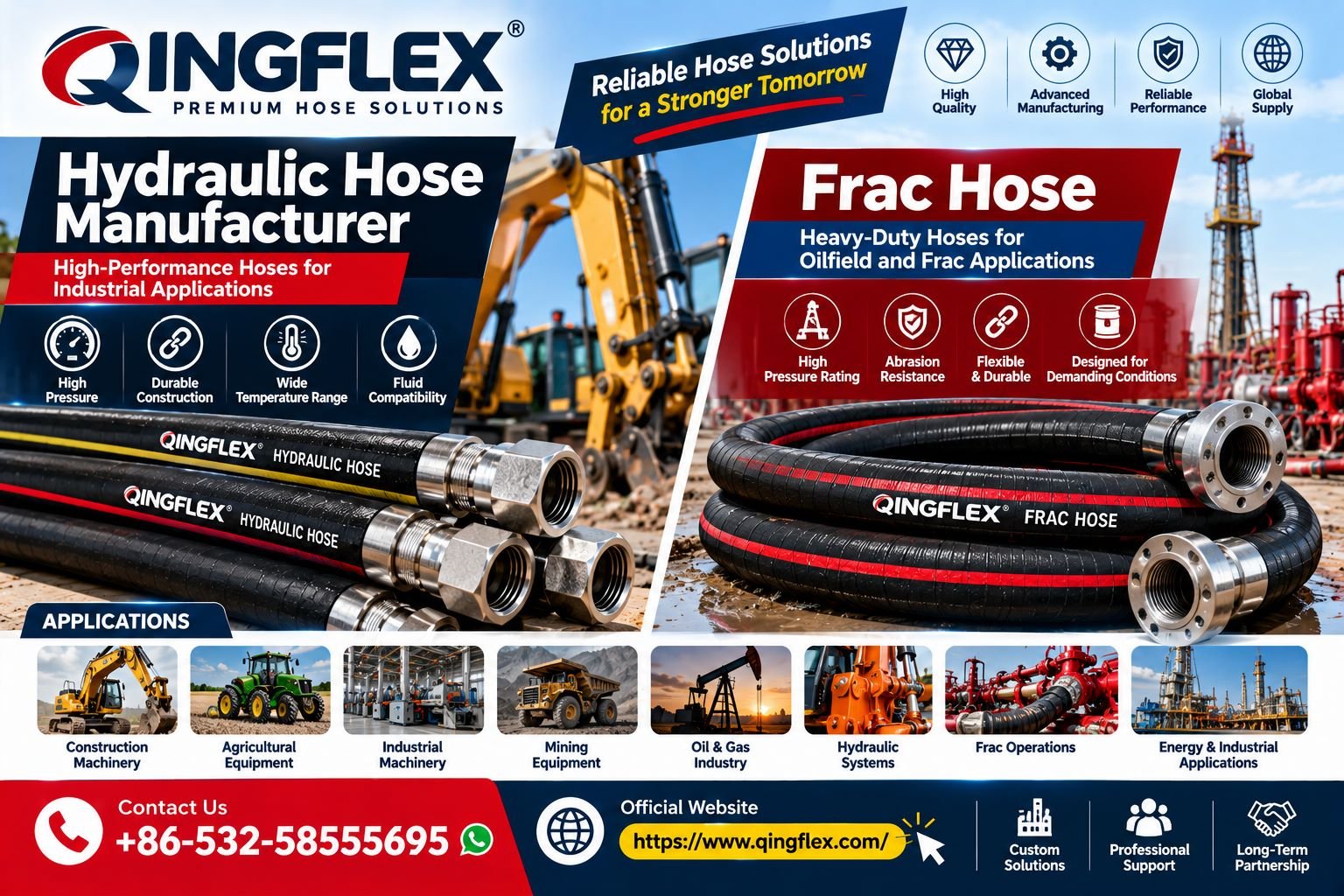
From cold oilfield locations to high-temperature industrial facilities, flexible hoses must maintain their intended mechanical properties while handling pressurized fluids.
For a Hydraulic Hose Manufacturer, understanding temperature-related performance is an important part of developing products for specialized industrial applications.
This consideration becomes particularly relevant in hydraulic fracturing operations, where a frac hose may encounter demanding fluid characteristics, environmental exposure, and substantial pressure requirements.
Temperature influences more than the exterior condition of a hose. It can affect material flexibility, sealing performance, reinforcement behavior, and compatibility with transferred fluids.
The engineering challenge is to ensure that the complete hose assembly remains suitable for its specified operating conditions rather than relying on a single material property.
Why Temperature Changes Affect Hydraulic Hose Performance
Industrial hoses generally contain multiple layers that perform different functions.
The inner tube provides a fluid-contact surface, reinforcement supports pressure resistance, and the outer cover protects against specified external conditions.
Temperature changes can influence these components differently.
In low-temperature environments, certain elastomeric materials may become less flexible. This can affect bending behavior and increase the possibility of damage if equipment movement exceeds the hose’s limitations.
At elevated temperatures, unsuitable materials may experience accelerated deterioration, reduced mechanical strength, or changes in sealing performance.
Temperature can also influence the properties of hydraulic fluids and other transferred media.
For these reasons, temperature compatibility should be considered alongside pressure ratings, hose dimensions, and chemical resistance.
An important engineering principle states:
Frac Hose Applications Introduce Additional Thermal Considerations
Hydraulic fracturing relies on pumping equipment to transfer specialized fluids through interconnected systems.
A frac hose intended for these applications must be selected according to the particular fluid-transfer service.
Environmental temperature is one consideration, but the temperature of the transferred fluid may be equally important.
A hose installed outdoors may experience external heating or cooling while simultaneously carrying fluid at a different temperature.
This difference creates additional considerations for the hose materials and connected components.
Important factors include:
- Low-temperature flexibility: Materials must remain suitable for the intended movement and installation conditions.
- Elevated-temperature resistance: Hose components must withstand the specified operating temperatures.
- Fluid compatibility: Inner-tube materials must be suitable for the fluid composition and temperature.
- Connection stability: Fittings and seals must perform within their approved operating limits.
- Environmental exposure: Sunlight, weather conditions, and external heat sources may influence material deterioration.
These factors should be evaluated together because a hose suitable for one operating environment may not perform appropriately in another.
Material Selection Plays a Central Role in Thermal Performance
A technically capable Hydraulic Hose Manufacturer evaluates material characteristics when developing products for demanding applications.
Different rubber compounds, thermoplastic materials, reinforcement structures, and protective covers offer different performance characteristics.
Inner Tube Materials
The inner tube must remain compatible with the transferred medium throughout the specified temperature range.
Material suitability depends on factors such as chemical composition, fluid temperature, and operating pressure.
Reinforcement Layers
Reinforcement structures provide mechanical strength and pressure resistance.
Their design must account for the intended operating environment and the interactions between the hose’s structural components.
Outer Cover Protection
The outer cover helps protect the internal structure against environmental influences.
Depending on the application, suitable cover materials may provide resistance to weathering, abrasion, oils, or specified temperature conditions.
Selecting the appropriate construction requires an understanding of the complete operating environment.
Why Thermal Cycling Deserves Greater Engineering Attention
A hose may experience changing temperatures as equipment operates under different environmental and process conditions.
Repeated heating and cooling can influence the behavior of certain hose materials and connections.
This process is commonly associated with thermal cycling.
Its potential effects depend on material construction, temperature range, exposure conditions, and operating stresses.
Engineering teams should consider whether changing temperatures affect flexibility, sealing performance, or dimensional stability.
A relevant technical observation is:
Testing requirements should be based on the specific hose design, its intended application, and relevant product standards.
Manufacturing Quality Supports Temperature-Resistant Hose Design
Material selection alone cannot establish reliable hose performance.
Manufacturing consistency is also important because each structural layer must be produced and assembled according to the intended design.
Production controls may involve material verification, dimensional inspection, reinforcement processing, and suitable quality testing.
For temperature-sensitive applications, manufacturers may evaluate product behavior under specified thermal conditions where relevant to the product requirements.
However, buyers should not assume that all industrial hoses undergo identical temperature testing.
Testing procedures, acceptance criteria, and certification requirements depend on the hose category and applicable specifications.
Clear technical documentation helps customers understand a product’s intended temperature range and operating limitations.
Installation Conditions Can Influence Thermal Exposure
Even a correctly selected hose may experience problems if its installation exposes it to unsuitable conditions.
Placing hoses near excessive heat sources can accelerate deterioration when the temperature exceeds the product’s specified limits.
Similarly, operating equipment in cold conditions may introduce flexibility considerations that affect routing and movement.
Installation planning should account for equipment layout, heat exposure, minimum bend radius, and manufacturer recommendations.
Protective covers or other approved measures may be appropriate for particular environments, but they should not be used to justify operation beyond the assembly’s specified limits.
Maintenance teams should inspect hoses for deterioration, unusual deformation, surface damage, and connection problems.
Any hose showing suspected damage should be assessed using authorized maintenance procedures.
Selecting Hose Products for Different Operating Climates
Industrial buyers should request detailed technical information before purchasing hose assemblies intended for challenging climates.
Important selection questions include:
- What is the specified minimum and maximum operating temperature?
- Is the hose compatible with the intended fluid across that temperature range?
- How do pressure and temperature conditions affect the approved operating limits?
- Are the fittings and seals suitable for the same environment?
- What installation and inspection procedures does the manufacturer recommend?
These questions help procurement teams distinguish between general product descriptions and documented application suitability.
Industry Perspective: Temperature Compatibility Supports Equipment Reliability
The wider significance of temperature-resistant hose engineering lies in maintaining suitable performance across changing operating environments.
For industrial equipment manufacturers and energy-sector operators, appropriate hose selection contributes to effective equipment integration and dependable fluid transfer.
A properly specified frac hose must satisfy its intended pressure, fluid, temperature, and mechanical requirements.
For manufacturers, clearly communicating these limitations supports more informed purchasing and engineering decisions.
Frequently Asked Questions (FAQs)
1. Why is temperature resistance important for hydraulic hoses?
Temperature can influence hose flexibility, material strength, fluid compatibility, and sealing performance. Selecting a hose within its specified temperature range helps maintain appropriate operating conditions.
2. Can a frac hose operate in extreme temperatures?
A frac hose may be designed for particular temperature conditions, but suitability depends on its documented specifications, construction materials, fluid compatibility, and intended service.
3. What materials are used in temperature-resistant hydraulic hoses?
Depending on the application, hose construction may incorporate engineered rubber compounds, thermoplastic materials, and suitable reinforcement structures. Material selection must match the operating requirements.
4. How does cold weather affect hose flexibility?
Low temperatures can reduce the flexibility of certain hose materials. This may influence bending behavior and movement limitations, making correct installation and product selection important.
5. What should buyers check when selecting a Hydraulic Hose Manufacturer?
Buyers should evaluate technical specifications, material compatibility, documented operating limits, applicable testing information, and the manufacturer’s ability to support application-specific product selection.
Media Contact
Department: Media Relations & Industrial Product Enquiries
Industry: Industrial Hose Manufacturing and Fluid Transfer Solutions
Contact: +86-532-58555695
Email: info@qingflex.com
Official Website: https://www.qingflex.com/